
Does this sound familiar?
I've been talking to people all day, I just need some time to myself to recharge my batteries before I can deal with humans again...
or
I need to zone out for a bit with some bad TV to put some gas back in the tank
or my favorite for the tech inclined...
I'm all out of social points, I need to reboot to flush my social buffer, and regenerate more points to spend
This last one is how it works in my mind, though admittedly I'm an introvert.
I always imagine I have a limited amount of social points (SP) and my mind is working this way:
- Talking to people: -10 SP
- Attending a party: -40 SP
- Reading a book: +30 SP
- A quiet evening at home: +50 SP
Naturally this leaves me looking for the most effective ways to get a +100 in social points. Or if you prefer the battery metaphor, the "fastest way to recharge your batteries".
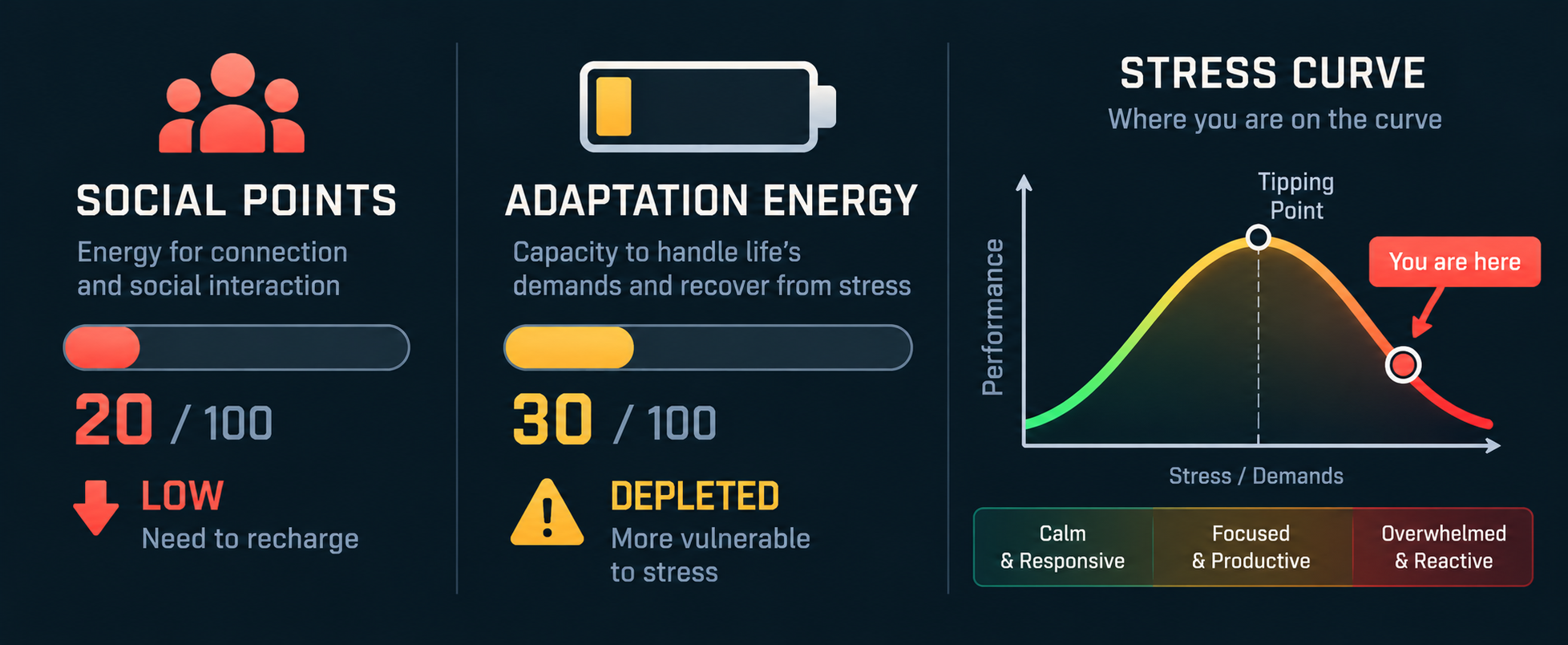
I think pretty much all daily meditators would agree that meditation is restorative but is there more to this than simply using meditation to rest and recover or recharge your batteries? What if meditation goes beyond the ability to recover but actually changes our long term ability to handle them?
Let's take a look at a few interesting concepts from stress research that can shed some light on these questions. I'm certainly no scientist or clinician but rather than attempting to explain the underlying physiology, let's use these concepts as useful metaphors that have helped my students understand why a daily meditation practice can be so valuable.
Adaptation Energy
In the mid-20th century, an endocrinologist named Hans Selye published results of his research on stress and human resilience. The research described what he called the "General Adaptation Syndrome" that contains the idea that all living beings have a limited reserve of what he termed "adaptation energy". This isn't a literal or measurable energy like calories, but rather a theoretical concept that serves as a useful metaphor for our capacity to handle, or adapt, to the demands of life. Demands in this context are things like change, surprises, and the physical, mental, and emotional challenges we all face every day.
Selye described this "adaptation energy" as what is activated when we encounter a stressor which can help us respond well. But if stress is chronic or overwhelming, and we never take time to recover, this energy becomes depleted. Over time, we can no longer respond effectively to challenges, and we shift from healthy adaptation into exhaustion. This is when you can imagine we'd experience burnout, irritability, emotional reactivity or defensiveness, anxiety, or health issues.
What daily meditators often experience feels like a replenishment of this adaptation energy (more social points!). When we meditate, we can experience a state of deep rest that sometimes feels different from ordinary relaxation or can even feel more restorative than sleep. The experience is as if meditation allows the mind and body to release accumulated tension, reset internal balance, and restore the adaptation energy we draw on to meet the demands of life. In this way, meditation functions like an internal battery charger. But what if meditation does more than just recharge the battery?
Human Function Curve
One way to visualize this is through the Human Function Curve. The Human Function Curve was developed by British cardiologist Dr. Peter Nixon in the late 1970s and early 1980s who focused heavily on stress, exhaustion, and cardiovascular health. Nixon created the "Human Function Curve" to explain the relationship between physiological arousal/stress and human performance, specifically to diagnose and intervene in stress-related conditions like hypertension and coronary heart disease.
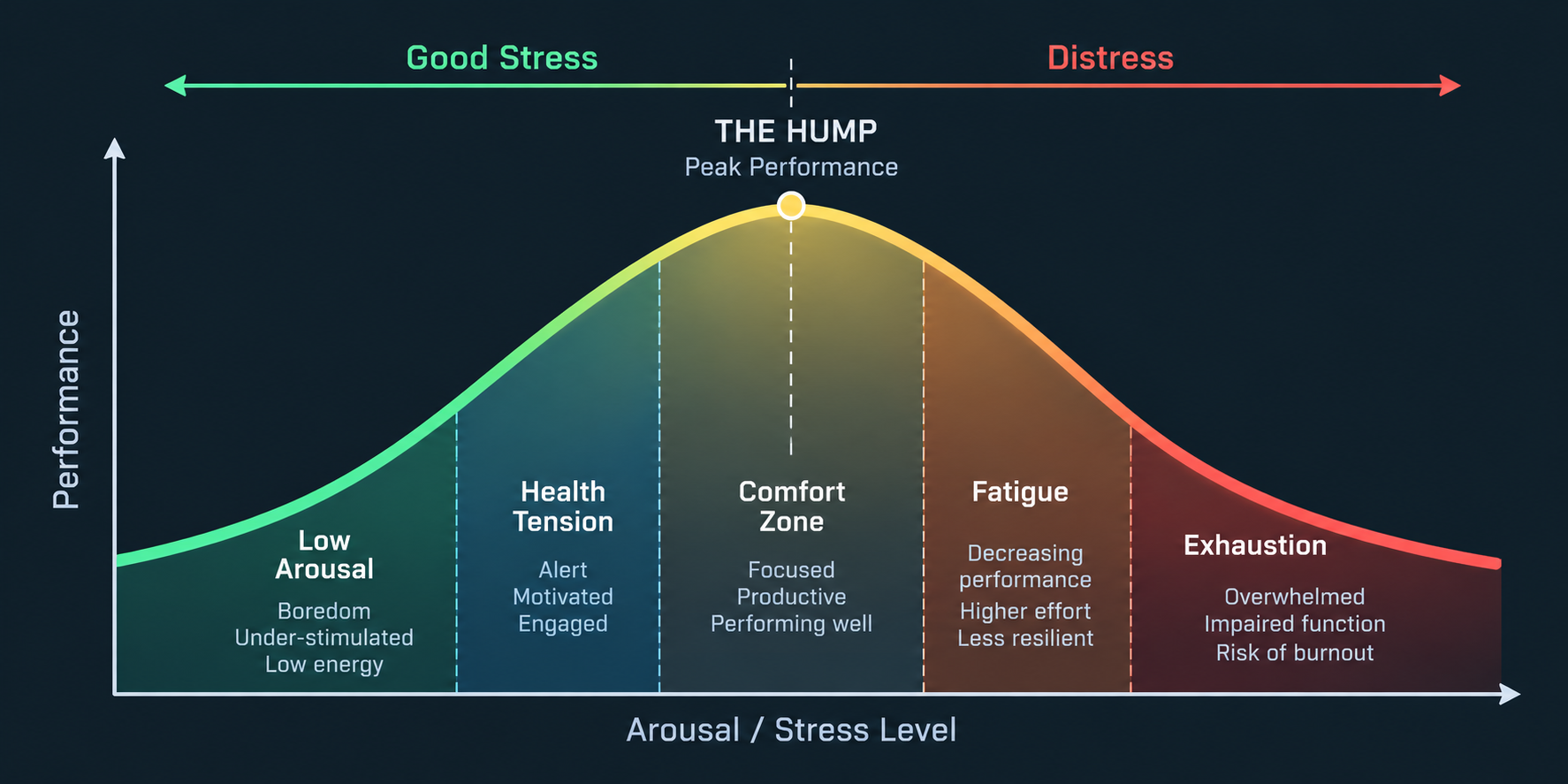
Notice the curve that rises as stress increases. At first, when challenges appear, performance improves. We are focused, alert, and motivated. But beyond a certain tipping point, the curve peaks and begins to fall. That is where stress turns from stimulation into strain. On the left side of the curve, increasing demands can help us perform at our best; beyond the tipping point, we begin to experience emotional reactivity, fatigue, and declining performance.
Regular meditation helps us better manage the demands that push us toward the tipping point of this curve. It can improve our ability to respond to stressors instead of reacting emotionally to them. In our adaptation energy metaphor, it's as though we have more capacity available to handle life's challenges. This gives us a wider margin between calm responsiveness and the tipping point of overwhelm.
Aspirin vs. Vitamin
Another useful analogy is that meditation can be treated more like an aspirin, or more like a daily vitamin. Some people, especially meditation app users, tend to treat meditation like a tool that they can apply, as needed. Much like the idea of taking an Advil only when you have a headache. Makes sense. Nothing wrong with using a guided meditation recording to relax when needed.
Daily meditation practice for the long-term is much more like treating meditation like a daily vitamin with the goal of supporting your wellbeing rather than waiting until something goes wrong.
When focused on building a consistent daily practice, it's as though we're maintaining a healthier baseline of "adaptation energy." Meditation becomes more than just a way to recover. Over time, the benefits of regular practice can accumulate, improving the overall quality of our mind and, most importantly, our wellbeing in daily life while we're not meditating.
In simple terms, meditation doesn't remove stressors from life, but it can renew our capacity to meet them. Taking an aspirin for the headache only scratches the surface. With regular practice, meditation can do more than replenish our adaptation energy. It can change how we experience and respond to life's challenges in the first place. This is where meditation can become an enabler of real change in our lives. Less emotionally reactive, more intelligently responsive.
The real benefit of daily meditation isn't just how you feel during those 20 minutes, but how you experience the rest of your day.
Want to comment on this post? Read it on Substack and join the conversation.
Keep reading
The Effort Knob - Finding the Right Intensity for Meditation
Understanding how to adjust the intensity of your meditation practice, from posture and alertness to attention and concentration.
AnnouncementsExploring a Secular Path to Buddhist Meditation
What I learned through the Secular Buddhist Tradition's instructor training program, what makes its approach different, and how it expands my meditation teaching.
Practice tipsDo You Need a Timer to Meditate?
Exploring the different ways to keep track of time during meditation, from simply watching a clock to using dedicated meditation timers.
Start with a free 30-minute conversation
Tell me what you're looking for. You'll leave knowing which practice fits you and how to begin. There's no cost and no commitment.
New to meditation? Join a free monthly intro session.
Prefer to write? Send me a message.