
The Effort Knob - Finding the Right Intensity for Meditation
Understanding how to adjust the intensity of your meditation practice, from posture and alertness to attention and concentration.
By Clint
Often when people explain meditation, it's from a process perspective. The steps you go through that make up a meditation session.
For some teachers, posture is critical. They'll tell you that you MUST sit in a specific position, with your back straight and unsupported. Others have you lay down. For some meditation is like a gym. It's where you go to train your mind for focus and concentration. And others... meditation is like a spa, where you go to relax, to let go.
While a process perspective is important, it fails to capture a critical characteristic that defines a gym versus a spa: effort.
Even when we're doing something as simple as observing the breath, how much effort should we actually be applying? Should you relax and allow your mind to settle naturally? Or should you actively work to sustain your attention and prevent your mind from wandering?
In this post let's explore an answer using the analogy I like to call the "effort knob".
Introducing the Effort Knob
Imagine approaches to meditation like a spectrum.
On one end, meditation is "effortless". You take your mind to the mental spa. At the spa, your goal is to relax the mind and release tension in the nervous system. You create ideal conditions for the mind to settle all on its own and just sort of "go with the flow".
On the other side, you're headed to the mental gym. Your goal is attentional stability. You have an object of meditation and you sustain your focus on it, allowing that mental stability to settle the mind through an intentional effort to sustain your attention.
Now imagine this spectrum is more like a knob. An intensity dial for meditation. It's not simply about how hard we concentrate. A knob that determines how much intentional effort we bring to different aspects of a meditation session, including posture, alertness, relaxation, and attention.
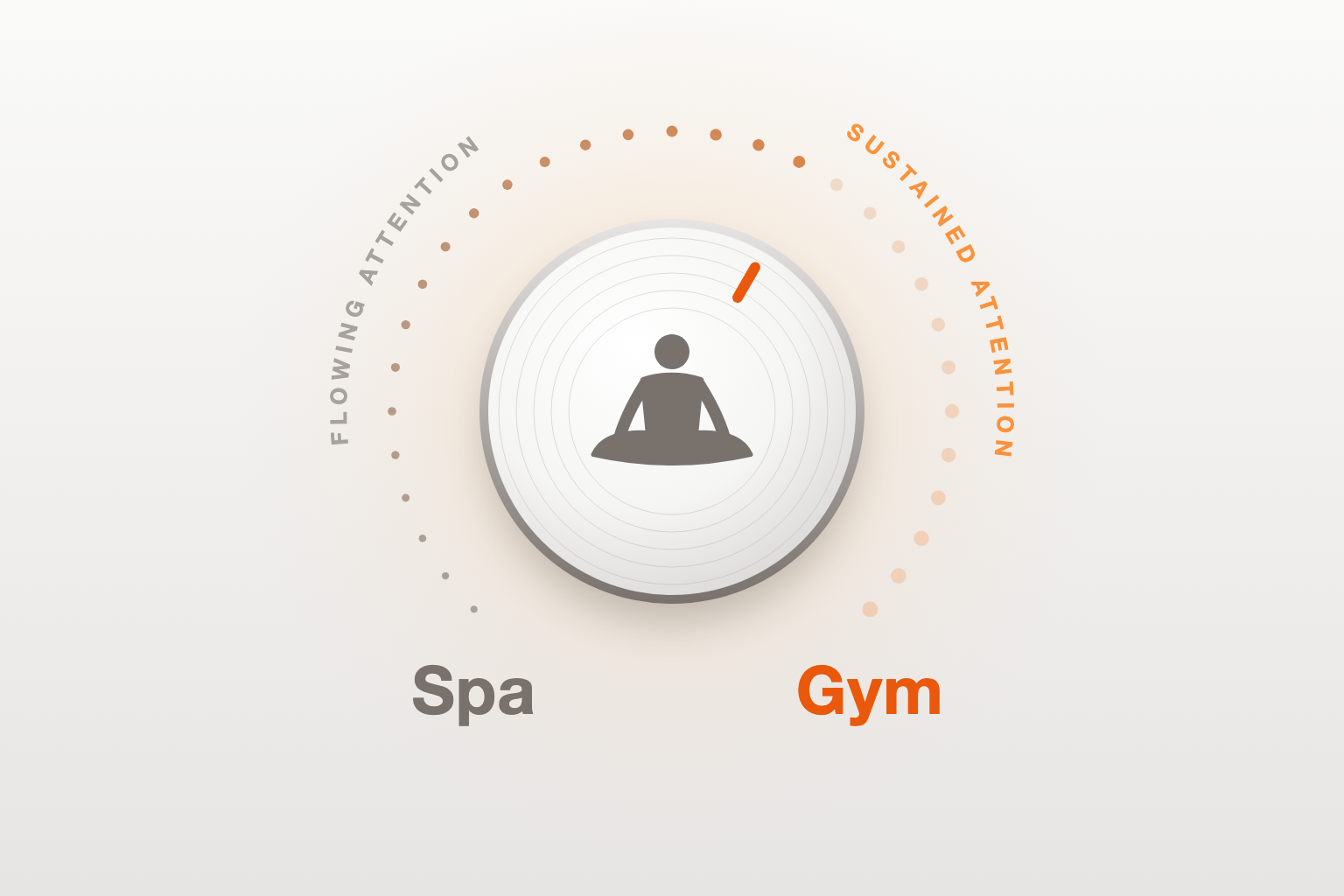
These aspects don't all have to move together either. For example, we might maintain an upright, alert posture while taking a very relaxed approach to attention.
Some techniques are literally defined by their effort level. There's no such thing as "high effort" Transcendental Meditation (TM) or 1 Giant Mind Being (1GM), for example. If you started adding posture, sustained attention, and noting to 1GM, well, you wouldn't be doing 1GM at all.
Some meditation techniques like 1GM explicitly teach effortlessness, while others ask us to intentionally train our attention. But even within techniques that call for intentional attention, there's often room to adjust how much effort we apply.
How might we recognize when we can benefit from turning the knob up or down, without necessarily changing the technique we're practicing?
Effortless Doesn't Mean Easy
One fascinating thing that was surprising to me when I began my meditation journey is that being effortless doesn't necessarily mean doing something easy.
In reality, especially for productivity-obsessed people like me, being effortless is VERY HARD!
Imagine you're wide awake, but wanting to fall asleep. Trying hard to sleep might have a diminishing return. The harder you try to sleep, the harder it might be. You have to create the right conditions to allow sleep to materialize naturally. (at least without medication...)
Effortless meditation can be like that. We're so used to building to-do lists, setting and achieving goals, and doing whatever it takes to get there. Simply allowing an experience to unfold without control can be surprisingly difficult. For many people, this is what leads them to meditation in the first place. The need to simply surrender that "human doing" mindset and rest in "human being".
Depending on how busy your mind is in a given meditation, you might notice yourself getting distracted immediately and feel the urge to suppress thoughts but in an effortless technique, that additional effort may take you further away from your goal, not closer.
The opposite can also be true. A sustained attention technique doesn't also mean it has to feel harder. With practice, sustaining attention can become increasingly natural and comfortable. The more you work out in the gym, the stronger you might become.
Just like a healthy workout at the gym, it doesn't mean we need to strain. We can work to sustain our attention while remaining relaxed, patient, and accepting of whatever happens.
In short then, the 'effort knob' isn't a way to describe how hard meditation can be, it's a measure of how much intentional effort to apply as we direct our attention.
Same Meditation Object, Different Effort Settings
Let's consider an example most meditators are familiar with. The simple idea of observing the breath.
In our example, the breath is simply our object of meditation. But how we relate to that object can vary considerably.
At one end of our spectrum, we can approach the breath with an almost effortless attitude, allowing attention to flow, similar to how we relate to the mantra in the 1GM technique. At the other, we can intentionally work to sustain attention on the breath, as we might in Calm Abiding meditation.
These approaches may be considered different meditation techniques, even though they share the same meditation object. Within techniques like Calm Abiding, we can also make smaller adjustments to the amount of intensity we're applying without abandoning the technique's fundamental instructions.
Let's compare the two ends of our spectrum using three aspects of meditation: Environment, Attention, and Attitude.
Low Effort Knob Setting
First we head to the spa for the mind. At this setting, our emphasis might be on relaxation, allowing, and releasing the need to control our experience.
Environment
We sit comfortably. There's no need to maintain a particular posture beyond what's comfortable and appropriate for staying awake. Eyes can be open or closed. You might begin with a few deep breaths or a gentle body scan to encourage relaxation.
Attention
We observe the breath without force or strain. There's no need to hold it in your attention or prevent your mind from wandering. Losing awareness of the breath is welcome and expected.
Attitude
We don't try to cultivate or prefer any particular experience. Allow thoughts to come and go without judgment. When you recognize that your mind has wandered, simply begin again. The only bad meditation is one you didn't do.
High Effort Knob Setting
Next, we head to the mind gym. The emphasis is on intentionally cultivating attentional stability and restful alertness.
Environment
We sit upright, preferably without supporting our backs, to encourage an alert mental state. You might also practice while walking or moving. Begin with a few deep breaths or a body scan if helpful, but avoid becoming overly relaxed or sleepy.
Attention
We place the breath in the foreground of our attention and intentionally work to sustain it. Be more vigilant about recognizing when attention has drifted and deliberately return to the breath.
Attitude
Treat distractions as opportunities to practice noticing and returning. You might use a mental note such as "thinking" when you realize you've become lost in thought. Maintain a patient, nonjudgmental attitude, even while applying more effort to sustaining attention.
Flowing Attention vs. Sustained Attention
Let's take a look at a key difference in these in the example. The relationship we're cultivating with our attention.
In our first example, we were a lot less interested in perfect posture or sustaining our attention on the breath. We had a much more relaxed attitude when our mind wandered, openly allowing it to happen and simply beginning again when we noticed. In other words, we allowed attention to "go with the flow".
In our next example, we focused more on posture and alertness, but more importantly, we put more effort into sustaining our attention on the breath. We applied effort not only to prevent mind wandering, but to detect and remediate when we noticed it happened.
In other words, we cultivated sustained attention, intentionally trying to remain with the breath rather than allowing attention to flow wherever it goes.
This is exactly what the effort knob is meant to represent.
While our examples illustrate two ends of the spectrum, there are many possible settings between them. Within Calm Abiding, for example, we might apply a lighter or stronger touch to sustaining attention while still following the basic instructions to notice distraction and return to the breath.
Of course no metaphor is perfect. Posture, attention, and attitude aren't all connected to a single dial. We can adjust the intensity of different aspects of meditation independently. We might choose a comfortable posture while still applying considerable effort to sustain attention, for example.
Can You Turn the Effort Knob Too Far?
It's also possible that you can go too far in a given direction.
Too Little Effort
Going too far toward relaxation can lead to sleepiness, or a dull mental state, which may not be what we intended for our meditation session.
At the gym, too little effort might also mean spending most of the session lost in thought rather than actually developing the skill you're trying to practice through repetition of noticing attention drift and returning to the breath, which can feel unproductive.
The idea of applying too little effort is relative to the technique you're practicing. (Remember, there's no such thing as "high-effort 1GM"). In a technique explicitly built around effortlessness, that same lack of concentration may be entirely appropriate, if not the point. In a technique intended to cultivate attentional stability, reducing effort so much that we're no longer attempting to sustain attention may undermine the practice.
Too Much Effort
Too much effort might simply be frustrating, if not completely counterproductive. Too much effort can also create tension and turn meditation into yet another task we're struggling to perform successfully rather than lead to calm, clarity, and connection.
In that context, intentional effort isn't the same as force or strain. We can actively work with our attention without demanding that our minds never wander. Eliminating thought is, of course, impossible. Attempting to will only create a frustrating feeling of failure that is one of the reasons people often give up on trying to meditate entirely. Thoughts are a part of meditation regardless of technique or effort setting.
Finding Your Sweet Spot
If you're feeling dull or sleepy while trying to develop attentional stability, perhaps a little more intentional effort would help. If you're becoming frustrated because your attention keeps wandering, you might benefit from turning the knob down.
Some days we might benefit from more relaxation and less effort. Other days, particularly when we're feeling dull or distracted during Calm Abiding, we might benefit from becoming more alert and intentionally engaging our attention.
If your attention is relatively stable and you're feeling comfortable, perhaps there's no reason to change anything.
There Is No Best Level
Turning the effort knob up isn't necessarily progress, and turning it down isn't a step backward. This isn't a difficulty level in a video game that we're trying to beat.
Similarly, the sweet spot isn't necessarily halfway between effortless and maximum effort. It's the amount of effort that's appropriate for the technique you're practicing and your mental and physical state.
For some techniques, effortlessness is fundamental to the instructions. For others, like Calm Abiding, there's room to adjust the intensity while still cultivating the same basic skill.
The setting should serve the practice, not the other way around. The important thing is to understand what kind of effort your technique calls for, and where appropriate, learn to adjust how much of that effort you apply.
Confused? It's understandable. Different techniques have different instructions, and even within a single technique, knowing when to apply more or less effort isn't always obvious. This is one of the benefits I found in my own practice of working with a meditation teacher and meditating with others in group meditations. Rather than trying to figure it all out on your own, you can discuss your experiences, get personalized guidance, and have someone coach you through finding the approach and level of intensity that's right for you.
The effort knob isn't about making meditation easier or harder. It's about learning to adjust the intensity of our practice when appropriate in a way that best serves us.
Want to comment on this post? Read it on Substack and join the conversation.
Keep reading
Do You Need a Timer to Meditate?
Exploring the different ways to keep track of time during meditation, from simply watching a clock to using dedicated meditation timers.
Practice tipsWhen should you meditate?
When is the best time to meditate? The answer depends on your life. Here's how to build a consistent daily practice, find the ideal times to meditate, and understand why I recommend twice a day.
Practice tipsWhy group meditations?
I was skeptical that meditating on Zoom with other people could be any different from meditating by myself. Then I tried it. Here's why group meditation helps a practice stick.
Start with a free 30-minute conversation
Tell me what you're looking for. You'll leave knowing which practice fits you and how to begin. There's no cost and no commitment.
New to meditation? Join a free monthly intro session.
Prefer to write? Send me a message.